
Travelers mapping out a trek through Mexico often hit the same fork in the road: Tulum vs Chichen Itza. Both are heavyweights in the world of archaeology, yet the experience at each site is night and day. One is a breezy coastal fortress; the other is a massive, inland powerhouse of ancient politics. While Tulum offers a glimpse into the Postclassic period, Chichen Itza showcases the Terminal Classic era’s architectural peak.
This guide breaks down every meaningful difference so you can figure out which ancient city actually fits your itinerary, your interests, and your tolerance for the sun.
Tulum vs Chichen Itza: A Clear Overview of Mexico’s Most Famous Mayan Ruins
When you put Tulum vs Chichen Itza side-by-side, you’re looking at two entirely different chapters of the Maya timeline.
Tulum was essentially a late-stage city. It was one of the final hubs built and inhabited by the Maya, holding its own even after the Spanish began their arrival. Its position wasn’t just for the scenery; it was a tactical trade center for moving jade and cacao along the coast.
The city was protected on three sides by limestone walls and on the fourth by approx. 39-40-foot (12-meter) cliffs, making it one of the few fortified Mayan settlements. Interestingly, the site was originally called Zamá (City of Dawn), a fitting name since the sun rises with theatrical perfection right behind the main temples (like El Castillo) every morning.
Chichen Itza is the dominant metropolis. Reaching its peak between the 9th and 12th centuries, it functioned as the beating heart of the northern Yucatán, politically, spiritually, and economically. The architecture here is a commanding, fascinating blend of Maya (Puuc style) and Toltec (Central Mexican) influences.
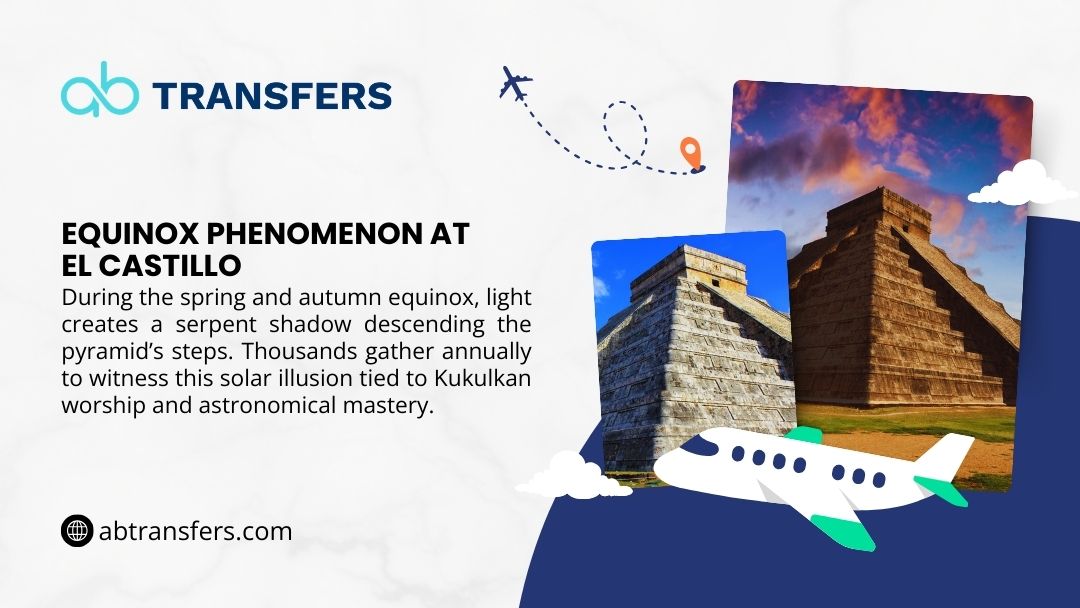
The sheer astronomical accuracy of the site is mind-blowing; during the spring and autumn equinoxes, the play of light and shadow creates an illusion of a serpent slithering down the main pyramid. It also served as a pilgrimage site for centuries due to its connection to the Sacred Cenote (Cenote Sagrado) through the white road (sacbe), which the Maya believed was a portal to the underworld, Xibalba.
Both sites represent the peak of Mayan ingenuity, but they do so through entirely different settings, timelines, and purposes.
Tulum vs Chichen Itza: The Facts That Matter Most
If you’re trying to make a quick call, here is the breakdown of how these two landmarks stack up in real-world conditions.
| Comparison Factor | Tulum Ruins | Chichen Itza Ruins |
| Overall size | Small to medium (~60 structures, 15 acres) | Extremely large (nearly 2 square miles) |
| Time needed to visit | 1–2 hours | 3–5 hours |
| Visual impact | Ocean views + ruins on Caribbean cliffs | Monumental architecture |
| Popularity | Very popular | One of the most visited in Mexico |
| Entrance cost | Lower | Higher |
| Physical effort | Easy walk | Long distances, limited shade |
| Climbing Status | No climbing allowed | No climbing allowed |
| UNESCO Status | Not on the World Heritage Site | World Heritage Site since 1988 |
Tulum works perfectly as a cultural side dish to a day at the beach or a cenote. Chichen Itza is the main course that demands a full day of commitment and planning.
Tulum vs Chichen Itza: Location, Setting, and Accessibility
Location usually acts as the ultimate tie-breaker for travelers based in the Riviera Maya. Tulum sits right on the edge of the Caribbean, just minutes from the boutique hotels and beach clubs. With the recent opening of the Tulum International Airport (TQO) and the Maya Train station (still requiring some transportation to reach the beach side), accessing these ruins has become significantly easier for long-distance travelers.
Chichen Itza is a different beast entirely, tucked away in the Yucatán interior (about 150-180 km west of Tulum and 200 km from Cancun), far from the sea and surrounded by thick jungle and open plains.
| Location Detail | Tulum | Chichen Itza |
| Region | Quintana Roo | Yucatán |
| Setting | Coastal cliffs | Inland plains |
| Distance from Cancun | ~130 km south | ~200 km west |
| Distance from Playa del Carmen | ~62-65 km | ~185-187 km |
| Distance from Tulum town | ~5 km | ~150 km |
| Transit Hub | Maya Train Station: Tulum | Maya Train Station: Chichen Itza |
Travelers staying in Tulum often combine the ruins with a quick swim, while a trip to Chichen Itza is a dedicated, full-day expedition.
Tulum Ruins or Chichen Itza: Which Site Fits Your Travel Style Best?
Tulum is for the Balanced Traveler. If you value a mix of culture and leisure, this site fits your schedule like a glove. You can wander the ruins in the morning, hike down to the beach below the cliffs for a swim, and still be back at a beachside cafe or a Tulum Pueblo by mid-afternoon. Its low-pressure layout makes it a hit for families, couples, and anyone who isn’t a fan of long, tiring bus rides or intense inland heat. It is also the best choice for amateur photographers who want high-contrast blue water in their shots.
Chichen Itza is for the History Buff. If seeing one of the most significant ancient cities on the planet matters more than convenience, this is your spot. The scale, the distance, and the layout demand patience and stamina. However, the payoff is a much deeper dive into Mayan civilization at its absolute height. The site offers a more complete look at the Mayan Ball Game and sacrificial rituals than almost any other site in the country. History-focused travelers and first-time visitors to Mexico often find Chichén Itzá to be an unmatched experience.
In short, Tulum fits travelers who want history without the disruption, while Chichen Itza fits those willing to put in the hours for cultural weight.
Tulum vs Chichen Itza Ruins: Highlights, Trade-Offs, and Nearby Stays
Both sites offer remarkable experiences, but neither is perfect. Understanding the pros and cons helps keep your expectations realistic.
| Aspect | Tulum Ruins | Chichen Itza Ruins |
| Key highlights | Sea views, murals, iguanas | El Castillo, Great Ball Court |
| Atmosphere | Relaxed, scenic | Grand, ceremonial |
| Main downside | Smaller scale | Crowds and intense heat |
| Shade availability | Limited | Very limited |
| Nearby stays | Beach hotels, boutique resorts | Piste village and Valladolid |
| Wildlife | Abundant iguanas/Coatis | Occasional Spider Monkeys |
Staying near Chichen Itza, particularly in the colonial town of Valladolid (approx. 40-45minutes away) or the village of Piste (2-3km away). Valladolid is also home to Cenote Zaci, a massive semi-open cenote right in the city center. Tulum visitors have the luxury of a huge range of coastal accommodation options right at their doorstep.
Tulum vs Chichen Itza: How to Visit the Ruins Smoothly
Actually reaching the sites is another huge part of the debate.
| Travel Aspect | Tulum Ruins | Chichen Itza Ruins |
| Public transport | Easy, cost effective(Colectivos/Buses) | Limited |
| Private transport | Simple, short | Highly recommended |
| Guided tours | Half-day | Full-day |
| Best arrival time | Early morning | At opening (8:00 AM) |
| New | Tulum Airport Shuttles | Maya Train Connection |
Many travelers choose private transport or organized tours to cut out the stress, especially when trying to tackle the long haul to Chichen Itza from the coast. Using a private driver allows you to stop at lesser-known cenotes like Oxman or Suytun on the return trip from Chichen Itza.
Tulum vs Chichen Itza: What the Ruins Actually Feel Like
The difference in atmosphere hits you the second you walk through the entrance. Tulum feels intimate. The structures are close together, the paths are short, and the ocean is almost always in your line of sight. The sea breeze helps take the edge off the heat, and the sound of waves follows you around.
Most visitors describe it as a calm, highly visual experience that feels emotionally engaging rather than exhausting. The presence of many giant iguanas (Black Spiny-tailed (ctenosaura similis)) lounging on the stones adds a prehistoric feel to the site.
Chichen Itza feels dominant. The distances between the temples are long (roughly 98-foot step/30 meters), shade is nearly non-existent, and the sheer scale of the architecture is designed to make you feel small. You can tell this wasn’t just a town; it was a massive ceremonial center built to impress.
It’s an intense experience that requires a lot of walking under the heavy Yucatán sun. The constant chirping of the Macabre jaguar whistles sold by vendors creates a unique, if sometimes noisy, auditory backdrop. Neither vibe is better; they just appeal to different expectations.
Tulum vs Chichen Itza: Crowds, Costs, and the Best Timing
Timing will make or break your trip more than you might expect.
| Factor | Tulum | Chichen Itza |
| Peak crowd hours | Mid-morning | Late morning to 2:00 PM |
| Heat exposure | Moderate | Very High |
| Best visit window | Early morning or late in the afternoon | Immediately at opening |
| Budget impact | Lower for off-season | Higher (State fees apply) |
Arriving early helps you avoid the crowds at both sites, but it becomes especially important at Chichen Itza if you want to experience the pyramid before crowds take over. Also, keep in mind that Yucatán (Chichen Itza) and Quintana Roo (Tulum) sometimes operate on different time zones during certain months.
Why Chichen Itza Became a Global Symbol of the Maya
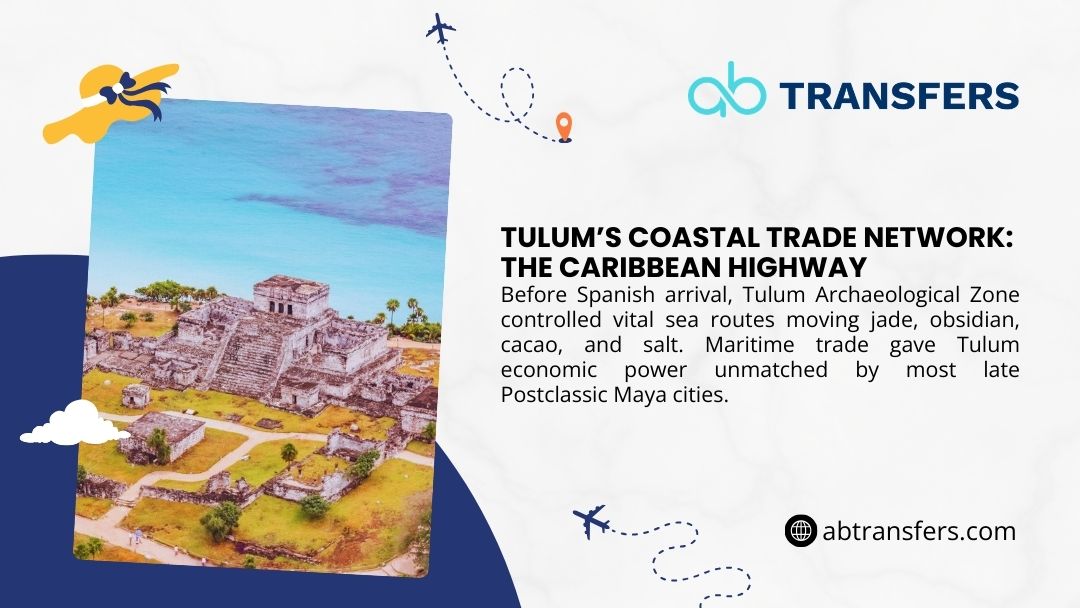
Chichen Itza didn’t just get famous by accident; it represents the absolute peak of Mayan scientific genius. The main pyramid, El Castillo (the Temple of Kukulcán), is essentially a giant stone calendar (Maya solar calendar (haab). Each side has staircasesof 91 steps (91×4=364), when added up with the top platform, equal 365 steps, representing the days in the solar year.
During the equinox, the sun creates an incredible shadow serpent that descends the steps. This level of precision shows an understanding of the stars that was centuries ahead of its time. Underneath the pyramid (approx. 65 feet deep), archaeologists have even discovered a hidden cenote, suggesting the structure was built to connect the heavens and the subterranean world.
Beyond the pyramid, the site features the largest ball court in Mesoamerica and an observatory aligned with the movements of Venus. Its status as a UNESCO World Heritage Site and one of the New Seven Wonders of the World in 2007 just cements what travelers have known for years: it is the most recognized ruin in the country for a reason.
Why Tulum Leaves Such a Strong Impression
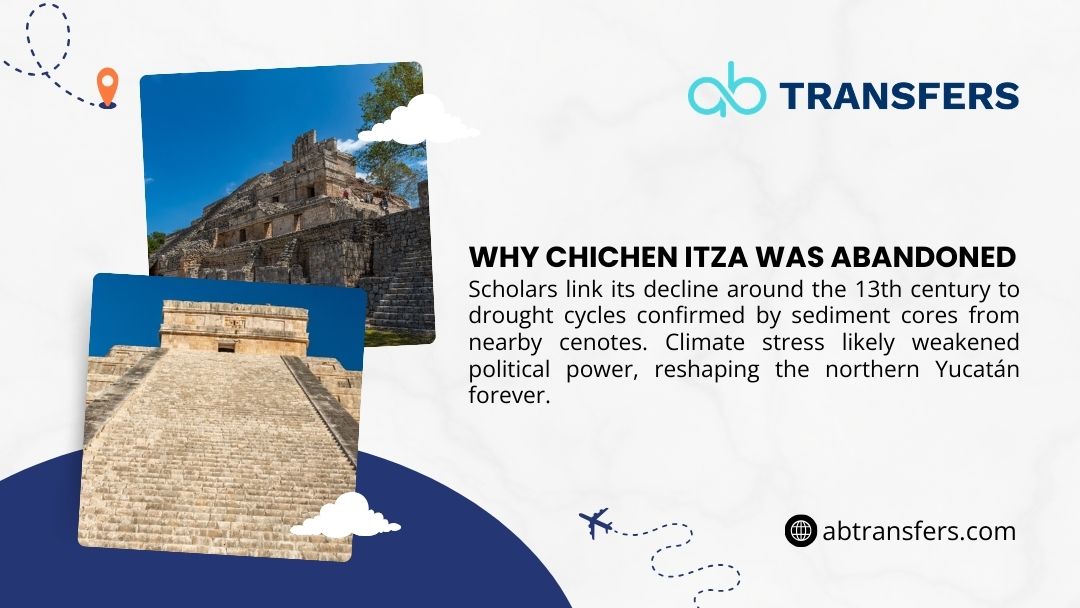
Tulum’s impact is all about the contrast. There are very few places on Earth where ancient stone temples sit on a cliff overlooking turquoise water. The visual mashup of ruins and the Caribbean Sea creates a memory that feels almost like a movie set.
Also, unlike the inland cities such as Chichen Itza, Tulum highlights the Maya’s role as expert navigators and traders. Its strategic position along Caribbean trade routes made it one of the most important port cities of the Late Postclassic period.
One of the most impressive buildings, Templo del Dios Viento (Temple of the God of the Wind), sits dramatically on a cliff edge; the wind whistling through holes in the structure warns the city of incoming hurricanes.
Accessibility is the other big win. You don’t need an elaborate logistics plan to visit. It feels approachable and connected to the modern world. Many travelers leave with a warmer emotional memory of Tulum, even while acknowledging that Chichen Itza is technically more impressive in terms of scale and architectural complexity.
What Travelers Usually Ask Before Visiting
Weather and timing usually dictate how much fun you actually have.
| Planning Factor | Tulum Ruins | Chichen Itza Ruins |
| Best time of day | Early morning / Late afternoon | 8:00 AM sharp |
| Best season | November to April | November to March |
| Heat levels | Manageable (Sea breeze) | Intense midday heat |
| Nearby activities | Beaches, snorkeling, cenotes | Cenotes, colonial towns |
| Cultural events | Local town festivals | Equinox gatherings |
| Drone Usage | Strictly prohibited | Strictly prohibited |
Choosing Based on Your Trip Style
If your vacation is mostly about recharging your batteries and seeing a few highlights, Tulum is the smart play. It’s flexible and doesn’t eat up your whole day. If your goal is to truly wrap your head around ancient Mexico, Chichen Itza is a non-negotiable, regardless of the travel time.
A lot of travelers with a week or more will actually visit both, starting with Tulum to get their feet wet and ending with Chichen Itza once they’ve adjusted to the heat and the pace of travel. For those who hate crowds, Coba is a third alternative often visited alongside Tulum.
So which one should you visit first?
If your trip begins in the Riviera Maya, starting with Tulum usually makes the most sense. It’s easier to access, gentler in pace, and helps you ease into the climate and rhythm of the region. Chichen Itza works best later in the trip, once you’ve adjusted to the heat and are ready for a full-day cultural deep dive. Travelers who reverse the order often report feeling worn out too early, while those who begin with Tulum tend to enjoy both sites more fully.
Tulum vs Chichen Itza: The Smarter Choice Depends on How You Travel
There is no single winner here. Tulum wins on scenery, ease of access, and chill factor. Chichen Itza wins on pure scale, historical depth, and cultural symbolism. The most satisfying trips are the ones that match the site to the traveler, not the other way around.
If you want to skip the headache of navigating public transport and high-pressure vendors, checking out the private options through AB Transfers can make either journey much smoother. From comfortable private vans to guided tours that help you bypass the worst of the crowds, it’s about making sure your trip feels like a vacation, not a chore. By 2026, combining these tours with a ride on the Maya Train is the most modern way to experience the region.
